The short version: buy a CO detector that is UL 2034 listed, matches your home’s power setup (battery, plug-in, or hardwired interconnect), shows a peak-CO reading if you want to diagnose low levels, and is sealed for a 7–10 year life. The picks below are chosen on specs and certification — not sponsorships.
Carbon monoxide is colorless, odorless, and tasteless. You cannot sense it, which is exactly why the detector you choose matters. This guide is a specs-first analysis: it is built from UL 2034 certification requirements, published manufacturer specifications, and the site’s troubleshooting knowledge — not from hands-on testing. We did not test these units in a lab, and we will not pretend we did. What we can give you is a clear, honest framework for choosing a detector that will actually protect your home.
What CO Detectors Must Do (The Standard, Briefly)
Every residential carbon monoxide alarm sold in the United States should be listed to UL 2034, the safety standard for single- and multiple-station CO alarms. “Listed” is not a marketing claim; it means an independent testing laboratory evaluated the unit against a published standard and the manufacturer is authorized to mark the product accordingly.
Here is what UL 2034 requires in plain terms, based on the verified standard:
- No alarm below 30 ppm. Residential CO alarms are designed not to alarm at concentrations under 30 parts per million. Low-level exposure is real, but the standard deliberately avoids nuisance alarms at background levels.
- Alarm thresholds engage from roughly 51+ ppm, scaled by exposure time. The higher the concentration, the faster the alarm must sound. At higher levels the alarm responds in minutes; at lower levels near the threshold it may take longer. This time-weighted response is the core of the standard.
- End-of-life signaling. Modern listed alarms must tell you when the unit has reached the end of its service life, typically 7–10 years from manufacture.
Why does “listed” matter? Because a detector that cannot prove UL 2034 listing may not meet the timing and threshold requirements that make the alarm useful. When you shop, look for the UL mark on the box or the back label. If it is not there, keep looking.
For the broader safety picture, see our Carbon Monoxide Detector Placement Guide and When to Replace a Carbon Monoxide Detector.
The Four Decisions Before Any Brand
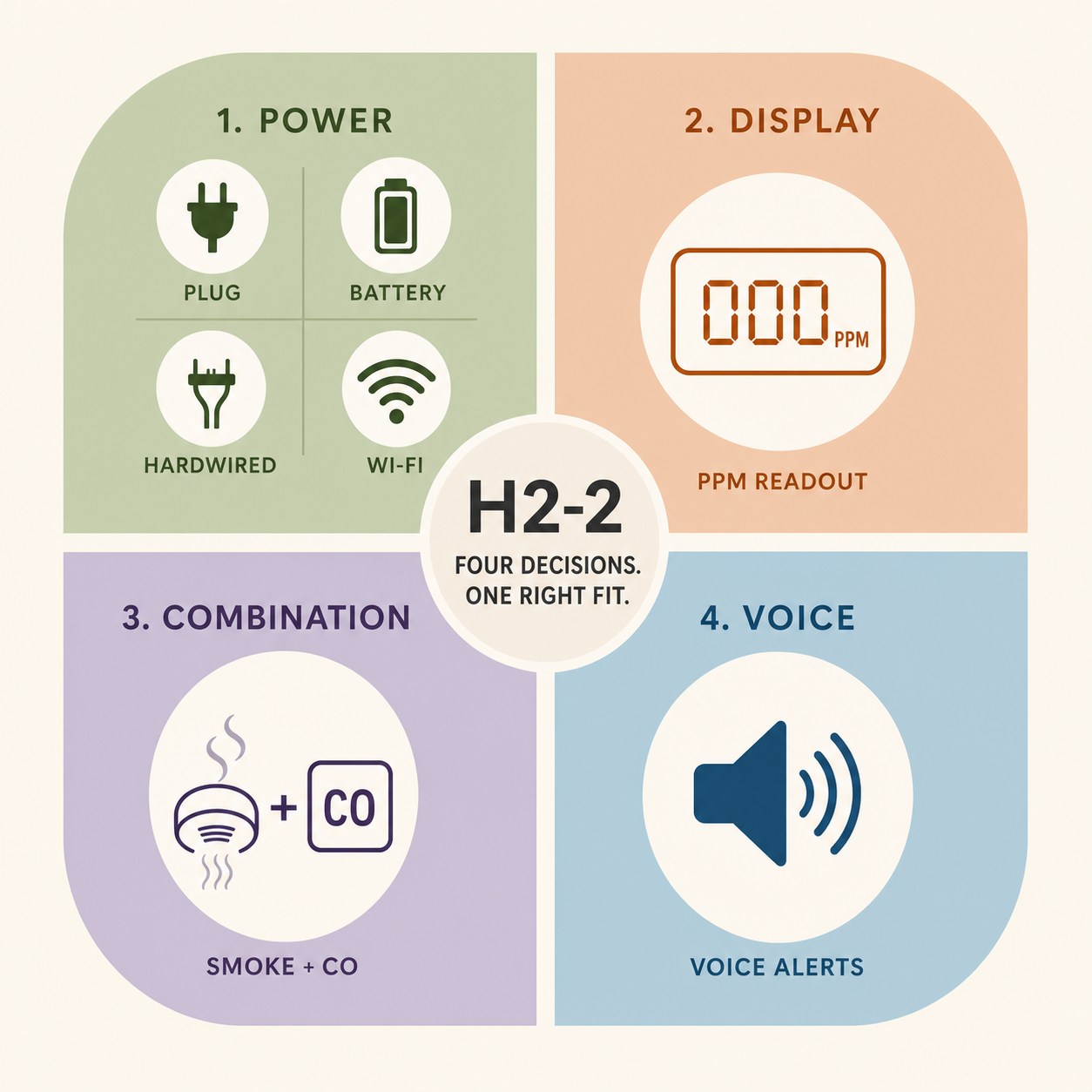
Before you compare brands, decide on four specifications. These matter more than the logo on the front.
1. Power Architecture
| Power type | Pros | Cons |
|---|---|---|
| Battery-only | Simple, no wiring, works anywhere | Batteries must be replaced; risk of dead-battery gaps |
| Plug-in with battery backup | Continuous power, backup during outages | Occupies an outlet; backup battery still needs replacement |
| Hardwired with interconnect | Whole-home alerting; one alarm triggers all | Requires wiring; professional install often needed |
| Smart (Wi-Fi) | Phone alerts, remote status | Depends on power and network; not required for safety |
Match the architecture to your home. Renters often prefer plug-in or battery units. Homeowners with existing hardwired smoke alarms may want a hardwired CO detector that interconnects. If you are unsure what you have, our Hardwired Smoke Detector Beeping? 6 Fixes Beyond Battery guide explains common wiring setups.
2. Display or No Display
A digital PPM (parts per million) display shows the current CO reading and, on many models, a peak-level memory that records the highest reading since the last reset. This is genuinely useful for diagnosing chronic low-level sources — a furnace that leaks a little, a water heater that backdrafts occasionally. Without a display, you only know the alarm is silent or sounding; you cannot see a slow climb.
If you have ever wondered “is there a small leak I cannot smell?” a display with peak memory is the feature that answers it.
3. Combination Smoke + CO vs CO-Only
Combination units detect both smoke and carbon monoxide in one device. They reduce the number of units on your ceiling and simplify maintenance. The trade-off: when one sensor reaches end of life, the whole unit is replaced, and the smoke and CO sensors may have different lifespans. For a deeper look at how these units signal problems, see Combination Smoke + CO Alarm Beeping Patterns.
4. Voice vs Tone
Some units announce “Warning: Carbon Monoxide Detected” in a spoken voice before or alongside the tone. This matters in households with children, elderly residents, or anyone who might not immediately understand a beeping pattern. Voice alerts are a feature, not a requirement — but for some households they are the difference between confusion and action.
Sensor Types, Honestly
Most residential CO alarms use an electrochemical sensor: a small cell that produces a current proportional to the CO concentration. These are accurate, stable, and the industry standard. Some older or less common units use biomimetic or metal-oxide sensors, but these are far less common in current retail models.
Here is the honest part: for most buyers, sensor type should not be the deciding factor. The four decisions above — power, display, combination, voice — have a much larger effect on whether the detector fits your home and gets maintained. A UL-listed electrochemical detector from a reputable brand is a sound baseline; the architecture and features are what separate good fits from bad ones.
The Picks: Specs-Verified
These picks are based on verified specifications and current retail price bands as of 2026-08-19. Prices change; always verify current pricing before purchase. Independent testing organizations such as Consumer Reports and Wirecutter have consistently highlighted Kidde and First Alert models in their 2026 coverage; we cite them at the class level, not as endorsements of specific units.
| Pick | Category | Power | Display | Sensor | Lifespan | Price band |
|---|---|---|---|---|---|---|
| First Alert CO605 | Best basic plug-in | AC plug-in + battery backup | No | Electrochemical | ~5–7 years | ~$30-40 |
| Kidde Nighthawk KN-COPP-3 | Best plug-in with display | AC plug-in + 9V battery backup | Yes, digital PPM + peak memory | Electrochemical | ~7 years | ~$25-45 |
| Kidde 30CUD10-class | Best sealed 10-year combo | Sealed 10-year battery | No | Electrochemical + photoelectric smoke | 10 years sealed | ~$40-60 |
| First Alert SCO-series class | Best sealed 10-year combo (alt) | Sealed 10-year battery | No | Electrochemical + photoelectric smoke | 10 years sealed | ~$40-60 |
| Hardwired interconnect (spec pattern) | Best hardwired interconnect | Hardwired + battery backup | Varies | Electrochemical | ~7-10 years | ~$40-80 |
First Alert CO605 — Best Basic Plug-In
- Power: AC plug-in with battery backup
- Display: None
- Sensor: Electrochemical
- Lifespan: ~7 years
- Price band: ~$30-40 street (First Alert Store $36.95; the CO606 successor runs ~$30) — verify current pricing
Best at: A no-frills, reliable plug-in CO alarm for bedrooms, hallways, or apartments where you want continuous power without paying for a display you may not use.
Honest limitation: No digital display means you cannot see current PPM or peak levels. If you suspect a chronic low-level leak, this is not the unit for you.
No-frills UL-listed plug-in with battery backup; reliable where you want continuous power without paying for a display.
Check price on Amazon Price & availability shown on Amazon.com — we may earn a commission.Kidde Nighthawk KN-COPP-3 — Best Plug-In With Display
- Power: AC plug-in with 9V battery backup
- Display: Digital PPM with peak-level memory
- Sensor: Electrochemical
- Lifespan: ~7 years
- Price band: ~$25-45 street (Consumer Reports lists $59.99 — street price is usually lower) — verify current pricing
Best at: Diagnosing. The digital display and peak memory let you see the highest CO level recorded, which is invaluable when you are trying to find an intermittent source.
Honest limitation: It occupies an outlet and the 9V backup battery needs periodic replacement. The display is useful but adds cost.
Digital parts-per-million display with peak-level memory — the pick for diagnosing an intermittent low-level source.
Check price on Amazon Price & availability shown on Amazon.com — we may earn a commission.Kidde 30CUD10-Class — Best Sealed 10-Year Combination
- Power: Sealed 10-year battery
- Display: None
- Sensor: Electrochemical (CO) + photoelectric (smoke)
- Lifespan: 10 years sealed
- Price band: ~$40-60 (verify current pricing)
Best at: Low maintenance. The sealed battery eliminates low-battery chirps entirely; instead, the unit signals end-of-life with a distinct alert. This is the class that replaces the most common nuisance chirp.
Honest limitation: When the 10-year life ends, you replace the entire unit. There is no display, so no PPM readout.
First Alert SCO-Series Class — Sealed 10-Year Combination (Alternative)
- Power: Sealed 10-year battery
- Display: None
- Sensor: Electrochemical (CO) + photoelectric (smoke)
- Lifespan: 10 years sealed
- Price band: ~$40-60 (verify current pricing)
Best at: The same low-maintenance combination role as the Kidde class, from a brand that independent testers also consistently highlight. Choose between the two based on availability and price.
Honest limitation: Same as the Kidde class: no display, whole-unit replacement at end of life.
Hardwired Interconnect — Best for Whole-Home Alerting
- Power: Hardwired with battery backup
- Display: Varies by model
- Sensor: Electrochemical
- Lifespan: ~7-10 years
- Price band: ~$40-80 (verify current pricing)
Best at: Larger homes where you need to hear the alarm from any floor. When one unit detects CO, interconnected units sound together.
Honest limitation: Requires wiring. If you do not have existing hardwired smoke alarms, this is a professional-install project, not a plug-in.
Installation Reminders That Make Any Pick Work
A good detector fails if it is placed badly. Follow these essentials:
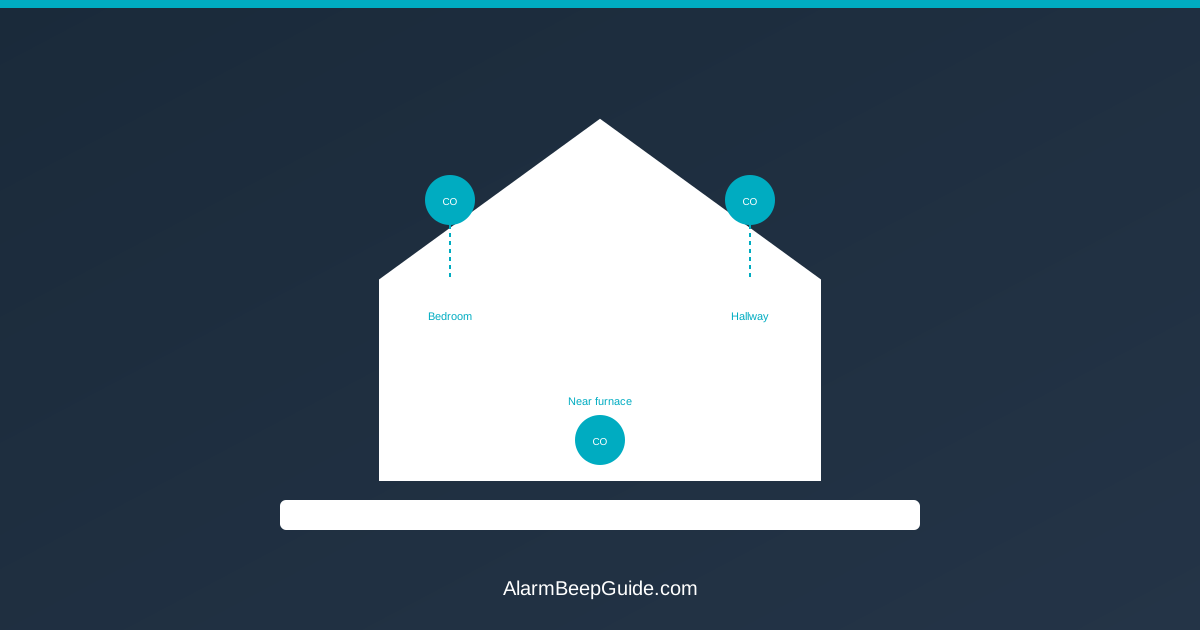
- Place at least one CO alarm on each level of the home and near sleeping areas.
- Keep units out of dead-air spaces, directly above fuel-burning appliances, and away from garages where exhaust can cause nuisance alarms.
- Avoid extreme temperatures and high humidity; these shorten sensor life.
- Replace the unit at end of life, not when it finally fails. See When to Replace a Carbon Monoxide Detector for the full timeline.
For room-by-room guidance, our Carbon Monoxide Detector Placement Guide covers the details.
What We Did NOT Test (The Trust Paragraph)
We did not buy these units, run them in a chamber, or measure their response times. This guide is a specs-based analysis: it is built from UL 2034 certification requirements, published manufacturer specifications, and the site’s troubleshooting knowledge. That is a deliberate choice. Specs-based analysis can be more reliable than “review” sites that claim hands-on testing without showing methodology, because certification requirements and published specs are verifiable. Where we are not certain of a specification, we flag it with rather than guess. Our Editorial Policy explains how we approach product guidance.
FAQ
How many carbon monoxide detectors do I need?
Should I buy a combination smoke + CO alarm or separate units?
Do smart CO detectors alarm without Wi-Fi?
When should I replace my carbon monoxide detector?
Related Articles
- Carbon Monoxide Detector Placement Guide — where to install
- When to Replace a Carbon Monoxide Detector — lifespan and replacement
- Carbon Monoxide Detector Beeping: What Each Pattern Means — decode the sounds
- Combination Smoke + CO Alarm Beeping Patterns — combo unit signals
- Best Smoke Alarms for Home Safety — the sibling buying guide
- Editorial Policy — how we approach product guidance
Image Prompts
Four-decisions selector graphic (H2-2). Placement: directly under the “The Four Decisions Before Any Brand” heading. Concept: a clean four-quadrant decision diagram showing power architecture (plug, battery, hardwired, Wi-Fi icon), display (PPM readout), combination (smoke+CO icon), and voice (speaker icon). Composition: flat vector illustration, warm neutral background, each quadrant color-coded, minimal text labels, consistent with the site’s calm editorial style.
Placement-awareness illustration (H2-5). Placement: in the “Installation Reminders” section. Concept: a cutaway home cross-section showing correct CO alarm placement near sleeping areas and on each level, with red X marks over dead-air spaces, garages, and directly above fuel-burning appliances. Composition: isometric-style vector, soft palette, clear room labels, arrows indicating correct vs incorrect positions.
Spec-label anatomy diagram (H2-1). Placement: in the “What CO Detectors Must Do” section. Concept: an annotated close-up of a CO alarm back label highlighting the UL 2034 mark, manufacture date, power type, and end-of-life date. Composition: flat vector with callout lines and short captions, white background, high contrast for readability, matching the site’s instructional diagram style.