You bought a carbon monoxide detector. You took it out of the box. But where exactly should you put it?
Placement matters more than most people think. A CO detector in the wrong location won’t detect carbon monoxide in time to warn you — and since CO is odorless, colorless, and invisible, you won’t know it’s there until the alarm sounds (or until it’s too late).
This guide covers the exact placement rules, room-by-room recommendations, and the common mistakes that make CO detectors less effective.
Does CO Detector Height Matter?
This is the most common question about CO detector placement — and the answer surprises many people.
Carbon monoxide has a molecular weight of 28, compared to air at approximately 29. This means CO is slightly lighter than air, but the difference is so small that CO disperses fairly evenly throughout a room. It doesn’t rise to the ceiling like hot smoke does, and it doesn’t sink to the floor.
Because of this, carbon monoxide detectors can be mounted on the ceiling or on the wall. Both placements are effective per NFPA 720 (now incorporated into NFPA 72 as of the 2025 edition). The key requirement is that the detector is placed where air can circulate freely around it.
Ceiling Placement
- Mount at least 12 inches from any wall, light fixture, or ceiling fan
- Do not mount directly above a fuel-burning appliance
- Do not mount in a corner — air circulation is poor in corners
Wall Placement
- Mount at least 6 inches from the ceiling (to avoid the “dead air” zone where air doesn’t circulate)
- Do not mount behind curtains or furniture
- Do not mount near windows or doors where outside air can affect readings
Both placements work equally well. The choice usually comes down to convenience and aesthetics. If you already have smoke detectors on the ceiling, placing CO detectors on the wall can make it easier to tell which alarm is sounding.
The NFPA 720 Placement Rules
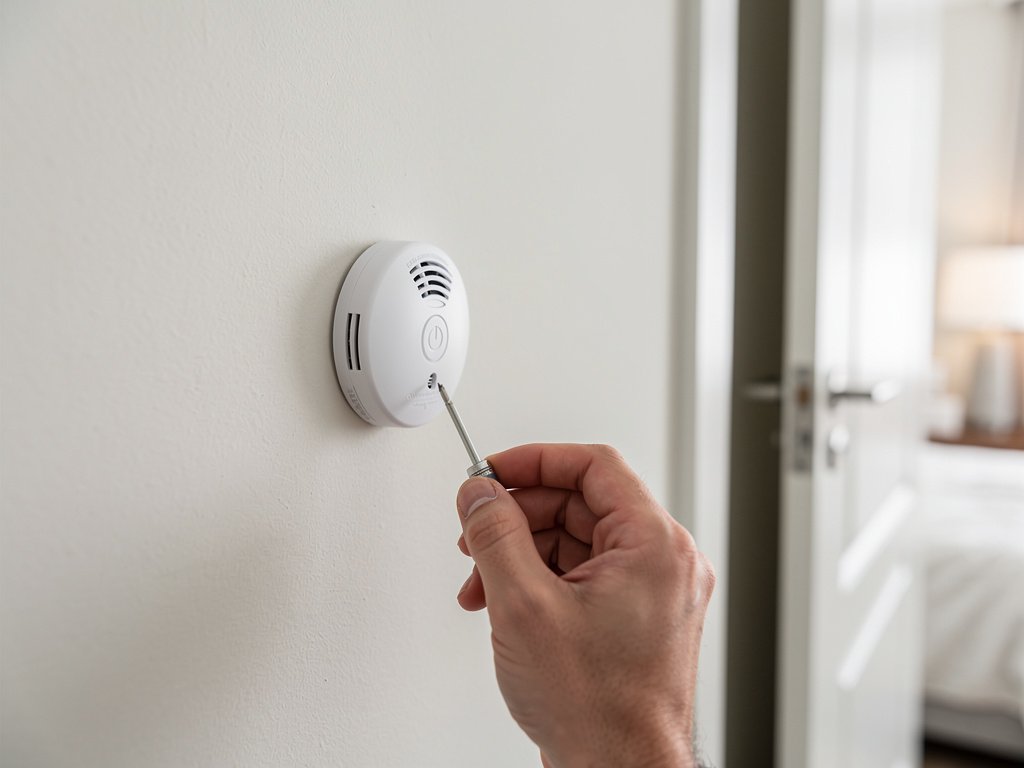
The NFPA provides specific placement guidelines for CO detectors:
- On every level of the home — including the basement, but excluding the attic unless it’s a living space
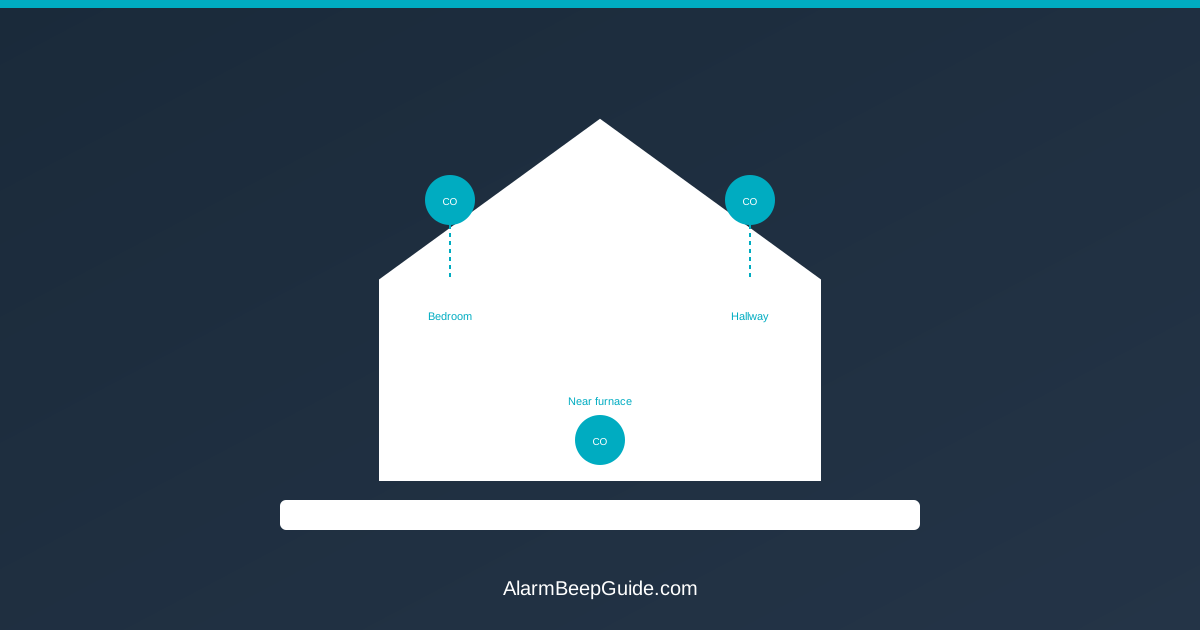
- Outside each sleeping area — within 10-15 feet of bedroom doors, so the alarm can be heard by sleeping occupants
- Near fuel-burning appliances — at least 10 feet from gas furnaces, gas water heaters, gas stoves, and fireplaces, but not closer than 10 feet to avoid false alarms from normal combustion byproducts
- In attached garages — if your garage is attached to the home, a CO detector near the connecting door can detect CO from vehicle exhaust
The 10-foot minimum distance from fuel-burning appliances is important. If the detector is too close, it may trigger from normal startup emissions — a brief puff of CO when a gas furnace ignites is normal. If it’s too far away, it won’t detect a malfunction quickly enough.
Room-by-Room Placement Guide
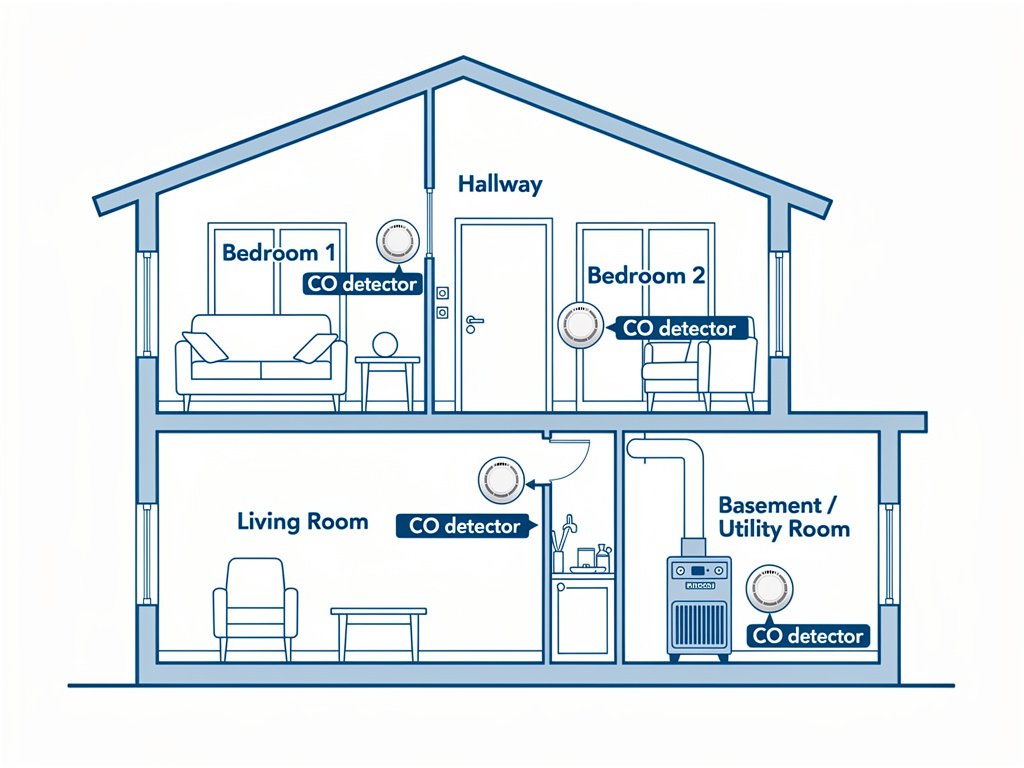
Bedrooms and Hallways
This is the most critical placement. CO is most dangerous when you’re sleeping — you can’t smell it, see it, or feel it, and the symptoms (headache, drowsiness, nausea) are easy to sleep through.
- Place at least one CO detector in the hallway outside bedroom areas
- If bedrooms are on opposite ends of a hallway, place one near each
- For maximum safety, install one inside each bedroom — especially if the bedroom has a gas fireplace or is above a garage
Kitchen
CO detectors in kitchens are tricky. Gas stoves produce small amounts of CO during normal operation, which can trigger false alarms if the detector is too close.
- Keep CO detectors at least 10 feet from gas stoves
- Don’t place them directly above the stove
- If the kitchen is open to a living area, a detector in the adjacent room is usually sufficient
Garage and Attached Spaces
Attached garages are a significant source of CO — car exhaust contains high levels of carbon monoxide, and even a few minutes of idling in a garage can produce dangerous levels.
- Place a CO detector near the door connecting the garage to the house
- Do not place the detector in the garage itself — extreme temperature changes and vehicle exhaust can trigger false alarms. Place it just inside the house, near the connecting door
- If you have an attached garage with a bedroom above it, that bedroom needs its own CO detector
Basement
Basements often house furnaces, water heaters, and other fuel-burning appliances — making them a primary CO source.
- Place a CO detector near the furnace and water heater
- Keep it at least 10 feet from the appliances
- If the basement is a living space or has a bedroom, add an additional detector in the sleeping area
RVs and Campers
RVs and campers are at high risk for CO poisoning because they’re small, enclosed spaces with potential CO sources (propane heaters, generators, stoves).
- Install a CO detector rated for RV use (standard home detectors may not work at extreme temperatures)
- Place near the sleeping area
- Test before every trip
- Never use a portable generator inside or near an RV
Where NOT to Place CO Detectors
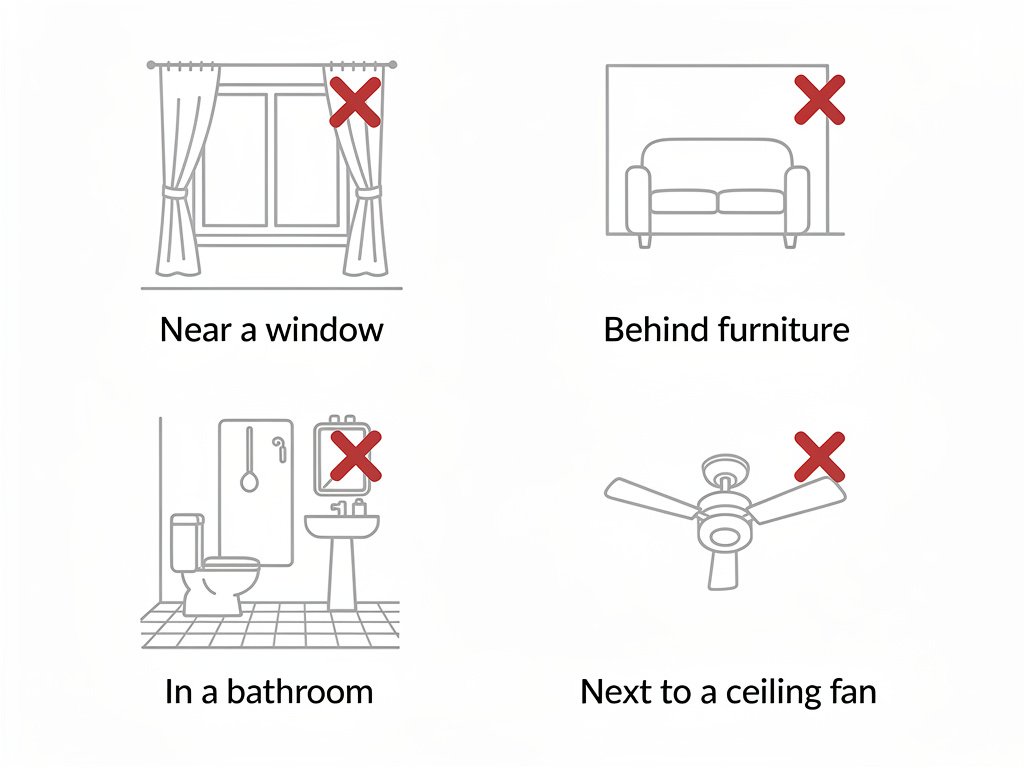
Some placements make your CO detector useless or cause constant false alarms:
- In the bathroom or near humid areas: Humidity can damage the electrochemical sensor
- Behind furniture or curtains: Blocked airflow means the detector won’t sense CO in the room
- Near windows or doors: Drafts from outside can dilute CO levels at the sensor, causing delayed detection
- In direct sunlight: Heat can affect the sensor’s accuracy
- Near ceiling fans: Air currents from fans can blow CO away from the detector
- In dead air spaces: The area where the wall meets the ceiling (within 6 inches of the corner) has poor air circulation — avoid this space for wall-mounted detectors
- Above or directly next to fuel-burning appliances: Too close, and normal combustion byproducts cause false alarms
- In uninsulated areas: Extreme heat or cold (like an uninsulated garage or attic) can damage the sensor and cause false readings
How Many CO Detectors Do You Need?
The minimum recommended by the NFPA:
- One on every level of the home
- One outside each sleeping area
The recommended best practice for maximum safety:
- One on every level
- One outside each sleeping area
- One in each bedroom (especially if the bedroom is above a garage or near a fuel-burning appliance)
- One near the furnace and water heater
For a typical two-story home with 3 bedrooms, this means 4-6 CO detectors. For a larger home with a basement and attached garage, 6-8 detectors provide comprehensive coverage.
If your state requires CO detectors by law, see our smoke detector laws by state guide for the minimum legal requirements in your state.
CO Detector vs. Smoke Detector Placement — What’s Different?
If you already have smoke detectors installed, you might wonder if you can use the same locations for CO detectors. Here are the key differences:
| Factor | Smoke Detector | CO Detector |
|---|---|---|
| Height | Ceiling (smoke rises) | Ceiling or wall |
| Near cooking? | 10+ feet from stove | 10+ feet from gas stove |
| Near bathroom? | Avoid (steam causes false alarms) | Avoid (humidity damages sensor) |
| Near furnace? | Not critical | 10+ feet (but near enough to detect malfunction) |
| In garage? | Not recommended | Near connecting door (not inside garage) |
| Minimum per home | 1 per level + 1 per bedroom | 1 per level + 1 outside sleeping areas |
If you have combination smoke and CO detectors, follow the stricter of the two placement requirements — which usually means following the smoke detector placement rules (ceiling, away from kitchen and bathroom). See our smoke detector placement guide for detailed smoke detector placement instructions, and our combination smoke/CO alarm beep pattern guide for how to tell which sensor is triggering the alarm.
Combination Smoke/CO Detector Placement
Combination detectors (which detect both smoke and CO in one unit) are increasingly popular. They simplify installation — one device instead of two — but placement is more constrained because you have to satisfy both requirements:
- Mount on the ceiling (smoke detectors work best on the ceiling)
- Keep 10+ feet from cooking appliances (both smoke and CO can trigger)
- Keep away from bathrooms (steam and humidity affect both sensors)
- Keep away from fuel-burning appliances at least 10 feet
If you can’t find a single location that works for both smoke and CO detection, install separate detectors. A smoke detector that can’t go where it needs to go is no better than no detector at all.
For more on choosing and maintaining combination detectors, see our guide on when to replace a CO detector and the CO detector beeping guide.
FAQ
Can I mount a CO detector on the wall instead of the ceiling? Yes. Carbon monoxide disperses fairly evenly in air, so wall mounting works just as well as ceiling mounting. If wall-mounting, place the detector at least 6 inches from the ceiling to avoid the dead air zone.
Do I need a CO detector if my home is all-electric? If your home has no fuel-burning appliances (no gas furnace, gas stove, gas water heater, wood-burning fireplace, or attached garage), the risk of CO is very low. However, an attached garage is still a CO source from vehicle exhaust. Many experts recommend at least one CO detector near an attached garage even in all-electric homes.
How long do CO detectors last? CO detectors typically last 5-7 years (shorter than smoke detectors’ 10 years). The electrochemical sensor degrades over time. Check the manufacture date on the back and replace accordingly. See our CO detector replacement guide for full details.
Why does my CO detector chirp every 30 seconds? A chirp every 30 seconds usually means the battery is low or the detector has reached end of life. Check our CO detector chirping guide for the specific meaning and how to fix it.
Can I place a CO detector near my gas fireplace? Yes, but keep it at least 10 feet away. Gas fireplaces produce small amounts of CO during normal operation, and a detector placed too close will give false alarms. Place the detector in the same room as the fireplace, but not directly above or next to it.
What’s the difference between a CO detector and a CO monitor? A CO detector sounds an alarm when CO levels reach dangerous thresholds. A CO monitor displays real-time CO levels on a screen, showing you lower levels that don’t trigger an alarm but may still be concerning. Some premium models (like the Nest Protect) function as both — they detect at alarm thresholds and also display low-level readings in the app.
Do CO detectors detect natural gas leaks? No. Carbon monoxide detectors detect CO, not natural gas (methane). Natural gas leaks have a rotten egg smell (added by the gas company as an odorant), while CO is odorless. If you have gas appliances, consider a separate natural gas detector if you’re concerned about gas leaks.
Should I put a CO detector in my child’s room? Yes, especially if the room is near a fuel-burning appliance or above an attached garage. Children are more susceptible to CO poisoning because they breathe faster and process CO more quickly. A CO detector in a child’s bedroom provides an extra layer of protection and gives parents time to respond.
Place It Right the First Time
A CO detector in the wrong spot gives you a false sense of security — you think you’re protected, but the detector can’t sense carbon monoxide where it actually accumulates. Follow the NFPA placement rules, avoid the common mistake locations, and make sure you have enough detectors to cover every level and sleeping area.
If your detectors are more than 5-7 years old, replace them regardless of placement — an old CO detector is as dangerous as no detector at all. And if you’re hearing beeping you don’t understand, check our CO detector beeping patterns guide before assuming the worst.