A combination alarm can warn about smoke, carbon monoxide, a low battery, a fault, or the end of its service life. Those signals are not interchangeable. If the unit is loud and repeating, or you cannot confidently identify the sound as a documented maintenance chirp, get people and pets outside first. For a possible CO alarm, the U.S. Consumer Product Safety Commission says to move to fresh air, call emergency services from outside, and stay out until responders say it is safe.
After the immediate safety response, find the make and model on the back of the unit. The model manual—not a generic sound chart—controls the meaning of its beeps, lights, reset procedure, battery, and replacement date.
Treat Loud Repeating Alarms as Urgent
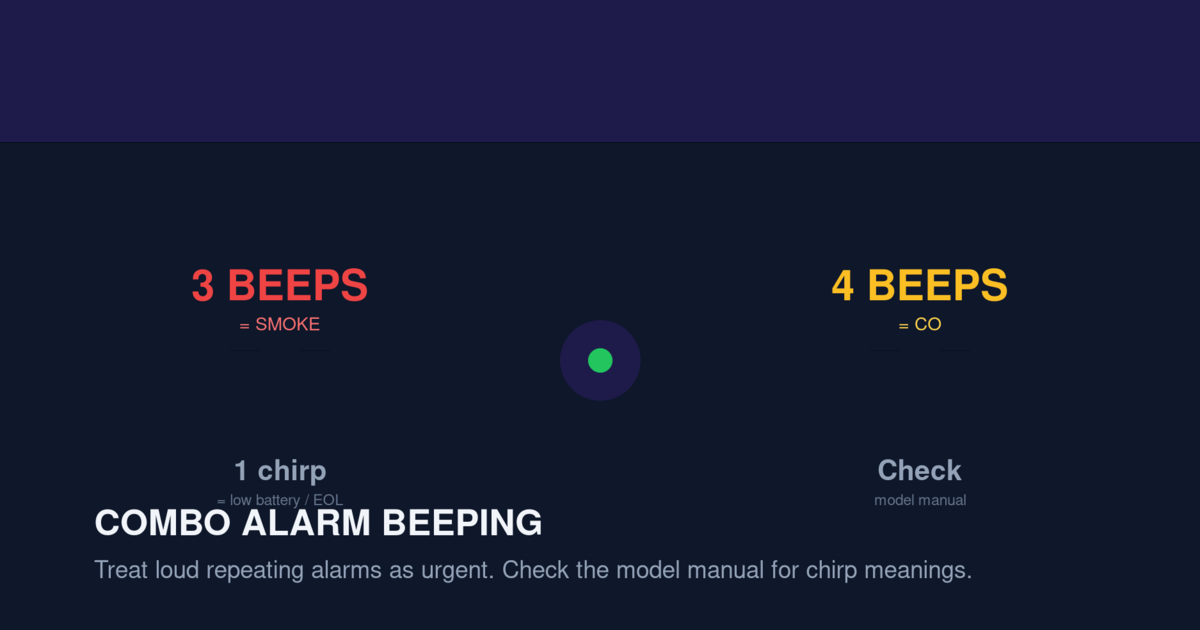
The NFPA says a continued set of three loud beeps on a residential smoke alarm means smoke or fire: get out, call 911, and stay out. Many combination alarms use a repeating four-beep cycle for a CO event, but the exact cadence and light signals still depend on the product. Do not stay inside to count beeps or search for a source.
- For a suspected CO alarm, use CO Detector 4 Beeps: Treat a Repeating Alarm as an Emergency.
- For a smoke alarm that is sounding loudly, follow your household fire-escape plan and call emergency services.
Manufacturer-Specific Alarm Patterns
Combination smoke/CO alarm patterns vary by manufacturer. Here is what verified documentation describes for major brands:
First Alert and BRK Models
According to First Alert’s SC5 specification sheet, the alarm patterns are:
| Condition | Sound Pattern | LED |
|---|---|---|
| Smoke alarm | 3 beeps, repeating | Flashes red |
| CO alarm | 4 beeps, repeating | Flashes red |
| Low battery | 1 chirp per minute | — (replace battery) |
| Malfunction | 3 chirps per minute | — (replace alarm) |
| End of life | 5 chirps per minute | — (replace alarm) |
These patterns are consistent across many First Alert and BRK combination models. Always verify against your specific model’s manual at firstalert.com/support.
Kidde Models
Kidde’s combination smoke/CO alarms use these documented patterns:
- Smoke alarm: 3 loud beeps, repeating
- CO alarm: 4 short beeps, followed by 5 seconds of silence, then repeating
- Low battery: A chirp every 30–60 seconds
- End of life: A chirp pattern that continues after battery replacement
Check Kidde’s support documentation for your exact model number.
Nest Protect
Nest Protect uses voice alerts and colored LED signals:
- Smoke alarm: Voice announcement (“Emergency, there’s smoke in [room]”) with loud horn
- CO alarm: Voice announcement (“Emergency, carbon monoxide in [room]”) with loud horn
- Heads-Up warning: Preliminary voice warning before full alarm for developing conditions
- Low battery: Chirp every 60 seconds, with app notification
- End of life: Chirp every 60 seconds with voice “Nest Protect has expired”
How to Tell Alarm Patterns Apart
The key distinction on combination alarms is between an emergency alarm and a maintenance chirp:
| Sound Type | Volume | Pattern | What It Means |
|---|---|---|---|
| Smoke alarm | Very loud (85+ dB) | 3 beeps, repeating | Smoke or fire — evacuate |
| CO alarm | Very loud (85+ dB) | 4 beeps, repeating | Carbon monoxide — evacuate |
| Low battery chirp | Soft | 1 chirp every 30–60 sec | Battery needs replacement |
| End-of-life chirp | Soft | Varies by model | Replace the entire unit |
| Malfunction chirp | Soft | Varies by model | Sensor fault — replace unit |
Rule of thumb: If the sound is loud enough to startle you or wake you from sleep, treat it as an emergency. If it is a quiet periodic chirp, it is a maintenance signal — but still check the manual to identify the exact cause.
A Short Chirp Is Not a Diagnosis
A periodic short chirp can be a low-battery reminder, an end-of-life signal, a trouble condition, or an error code. Once you have confirmed the unit is not issuing an active alarm:
- Check the label for the make, model, battery type, manufacture date, and stated replacement age.
- Install only the battery type named by the manufacturer and make sure the compartment is completely closed. An unlatched battery door is one of the most common causes of persistent chirping.
- Use the manual’s reset or test procedure — not a sequence borrowed from another brand. Reset steps differ significantly between First Alert, Kidde, and other manufacturers.
- Replace the whole combination alarm if the label says it has reached end of life or the manual identifies the signal as a fault that requires replacement.
Do not remove a battery, disconnect power, or tape over the speaker as a solution. That leaves the home without the alarm’s protection.
Why Model-Specific Instructions Matter
A combination device has more than one sensor and may have separate sound, voice, color, or display indications. A test button checks basic circuitry; it does not tell you whether there is CO in the home or prove that every sensor is accurate. Follow the manual for your exact product and arrange qualified service for fuel-burning equipment after a possible CO event.
If the alarm is hardwired or interconnected, do not assume every sounding unit is the source. One unit sensing smoke or CO will trigger all interconnected alarms. Use the manufacturer instructions and start with Hardwired Smoke Alarm Chirping: Safe Troubleshooting.
FAQ
Is three beeps always smoke and four beeps always carbon monoxide?
On many combination alarms from First Alert, Kidde, and BRK, three beeps indicates smoke and four beeps indicates CO. However, these patterns are not universal — always verify against the manual for your specific model. Treat a loud repeating sound as urgent regardless of the beep count, and evacuate if there is any doubt.
Can I hush a combination alarm that is sounding?
Do not use a silence or hush control to investigate a possible smoke or CO event. Get outside and call emergency services first. Use a model’s hush function only as the manual directs after you have confirmed the cause is not an emergency (e.g., cooking smoke or shower steam).
Does a chirp mean the combination alarm is safe to ignore?
No. A chirp may be a battery, fault, or end-of-life signal. Check the model documentation and keep the unit protected until you have corrected the issue or replaced it.
How long do combination smoke/CO alarms last?
Most combination smoke/CO alarms have a 10-year certified life from the manufacture date, per UL 217 and UL 2034 standards. The CO sensor degrades over time and cannot be repaired or recalibrated. When the unit reaches its replacement age, replace the entire detector. See our CO detector replacement guide for details.
My combination alarm chirps after I changed the battery. What should I do?
First, confirm the battery is the correct type and properly seated with the compartment fully closed. Then try the manufacturer’s documented reset procedure. If the chirp persists, check the manufacture date — if the unit is 10 or more years old, it is signaling end of life. Replace the entire unit.
Can I replace just one alarm in an interconnected system?
Sometimes, but compatibility matters. All interconnected alarms should be from the same manufacturer and compatible model family. Mixing brands or incompatible models in an interconnected system can cause false alarms, communication failures, or chirping. When replacing one unit in an interconnected system, check the manufacturer’s compatibility guide.
Sources
- National Fire Protection Association: Smoke Alarms
- U.S. Consumer Product Safety Commission: Carbon Monoxide Questions and Answers
- Kidde: Why Is My Carbon Monoxide Alarm Beeping or Chirping?
- First Alert SC5 Specification Sheet