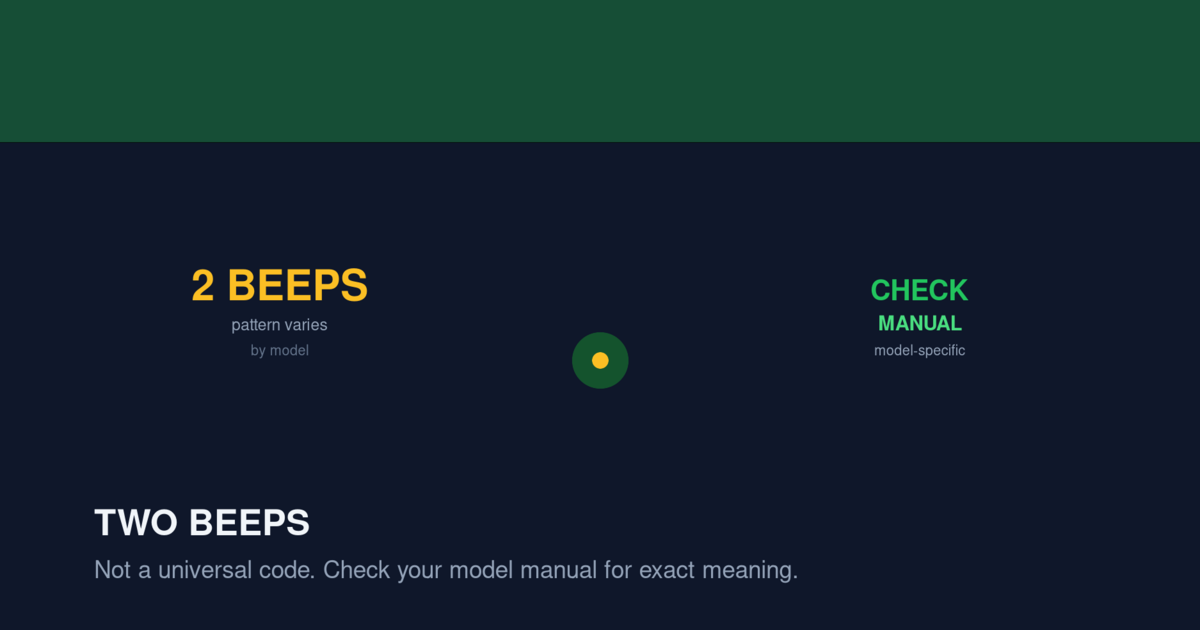
Always check your model’s manual for the exact chirp meaning. Beep patterns vary by manufacturer, model, and production year. The guidance below is based on NFPA recommendations and manufacturer support documentation, but your alarm may differ. Two beeps is not a standard emergency alarm pattern — three beeps means fire and four beeps means CO.
If you searched “smoke detector 2 beeps meaning”, you need a fast, reliable answer. Two beeps or chirps from a smoke detector — whether every 30 seconds, every minute, or a double-chirp pattern — each signal something specific. This US-focused guide explains every two-beep pattern, gives you a safe diagnostic order, and tells you when to replace instead of reset.
Quick Answer
- Two chirps every 30–60 seconds = most likely low battery or end-of-life warning
- Two rapid beeps in succession, repeating = possible sensor fault or malfunction on some models — check your manual
- Three loud beeps repeating = standard fire/smoke alarm — evacuate immediately
- Four loud beeps repeating = carbon monoxide alarm — evacuate immediately
- Start with: identify which unit → check battery → reset → clean → check manufacture date
What This Page Covers
- What 2 beeps or 2 chirps typically means
- Brand-specific meanings (Kidde, First Alert, Nest Protect)
- Safe fix order for battery and hardwired units
- When 2 beeps means replace, not reset
- FAQ
What 2 Beeps Usually Mean on a Smoke Detector
Two short chirps or beeps on a smoke alarm most commonly indicate one of these four conditions:
1. Low Battery (Most Common)
The most frequent cause of any irregular chirping — including two short beeps — is a low or failing battery. Most smoke detectors use a 9V battery or AA/AAA cells. When voltage drops below a threshold (usually around 7V for a 9V battery), the detector emits periodic chirps to alert you.
Signs it’s a battery issue:
- Beeping started suddenly or after a power outage
- The chirp is a short, soft, single or double tone (not the loud alarm)
- Your last battery replacement was more than a year ago
- The detector’s LED may flash red more frequently
Fix: Replace the battery immediately with a fresh alkaline battery. Do not use rechargeable batteries in smoke detectors — voltage irregularities can cause false chirping. After replacing, hold the test button for 3–5 seconds to clear residual charge, then confirm the alarm sounds normal.
2. Backup Battery Low (Hardwired Units)
Hardwired smoke detectors still have a 9V backup battery for power outages. Even if your unit is connected to household wiring, a weak backup battery will trigger chirping. This is a very common cause of chirping that confuses homeowners — they assume “it’s hardwired, it doesn’t need a battery.”
It does. Replace the backup battery in hardwired units using the same process as battery-only units.
3. Sensor Fault or Malfunction Code
Some brands use two sequential beeps to indicate a sensor error or chamber contamination. This is less common than battery issues but occurs more often with units that are 5+ years old.
On Kidde units: Check your model manual. Kidde’s published support documentation lists low battery, improper battery installation, and end of life as the most common chirp causes. A specific two-beep pattern is not documented as a standard Kidde signal.
On First Alert units: First Alert uses specific chirp rates (e.g., 1 chirp/min for low battery, 5 chirps/min for end of life). Two beeps is not a standard First Alert alarm pattern — check your model manual.
4. End-of-Life Warning
Smoke detectors have a functional lifespan of 10 years (NFPA standard). When a unit reaches end of life, it chirps — sometimes in patterns that differ from the standard low-battery single chirp. If your unit is more than 10 years old and you’re hearing irregular two-beep patterns even after replacing the battery, the unit itself needs replacement.
Check the manufacture date: Look for a sticker on the back or inside the battery compartment. If manufactured more than 10 years ago, replace the unit regardless of how it seems to be working.
Brand-Specific 2-Beep Meanings
Different manufacturers use different chirp and alarm codes. Here’s what two beeps means on the most common US brands:
| Brand | What to check |
|---|---|
| Kidde | Kidde’s support documentation lists low battery, improper battery installation, and end of life as the most common chirp causes. Two-beep patterns are not a standard Kidde alarm signal — check your model manual. |
| First Alert | First Alert uses specific chirp rates for different conditions (e.g., 1 chirp/min for low battery, 5 chirps/min for end of life). Two beeps is not a standard First Alert pattern — check your model manual. |
| Nest Protect | Nest uses voice announcements and app notifications, not beep codes. If you hear beeping, check the Nest app for the specific alert. |
| Other brands | Always check your model manual. Chirp patterns and meanings vary significantly between manufacturers and models. |
Fix Order: Step by Step
Follow this order to diagnose and fix two-beep chirping:
Step 1: Identify which unit is beeping In a multi-room home, pinpointing the source matters. Walk room to room when the chirp occurs. The chirping unit will have a red LED that flashes simultaneously with the sound.
Step 2: Replace the battery Remove the unit from the ceiling mount (twist counterclockwise). Open the battery compartment. Replace with a new 9V alkaline battery (or AA/AAA depending on model). Press and hold the test button for 5 seconds after replacement to reset the unit.
Step 3: Reset the unit After battery replacement, some units retain a memory of the fault. To fully reset: remove battery → hold test button 15 seconds → reinstall battery → press test button to confirm normal alarm sound.
Step 4: Clean the sensing chamber Dust, cooking grease, and insects can contaminate the sensing chamber and trigger fault codes. Use a can of compressed air to blow gently into the vents. Avoid vacuum cleaners — they can damage sensors.
Step 5: Check the manufacture date If the unit is 10+ years old, replace it. No amount of cleaning or battery-swapping will fix a detector that has reached end of life.
Step 6: For hardwired units — check interconnect wiring If you have interconnected hardwired smoke detectors and one is chirping even with a fresh battery, one unit in the chain may have a fault. Disconnect each unit one at a time to identify the source unit, then replace that unit.
When to Call a Professional
In most cases, smoke detector chirping is a DIY fix. However, call a licensed electrician or alarm technician if:
- You have a monitored security system and cannot silence the alarm through your panel
- Multiple hardwired units chirp simultaneously after all batteries are fresh
- You have 4-wire smoke detectors wired into a central fire panel (commercial installation)
- The chirping persists after replacing the unit with a new one (possible wiring issue)
Two Beeps vs. Two Chirps: Is There a Difference?
It’s worth clarifying terminology before panicking. In the fire safety world, there’s an important distinction:
- Chirp: A short, soft, single-tone sound (like a bird). Usually a maintenance notification — low battery, end-of-life, or fault code.
- Beep / Alarm tone: A longer, louder tone. Part of the full alarm pattern.
When people search “smoke detector 2 beeps,” they often mean either:
- Two short chirps, repeating periodically — this is almost always a maintenance alert
- Two loud alarm tones in an emergency pattern — this requires immediate action
If you’re hearing two loud, prolonged tones that repeat continuously: This could be a genuine fire or CO alarm. Evacuate the building immediately, call 911, and do not assume it’s a false alarm until confirmed safe.
If you’re hearing two soft short chirps every 30–60 seconds: This is a maintenance notification. Still important, but not an emergency.
Interconnected Smoke Detectors and the 2-Beep Pattern
If your home has interconnected smoke detectors (all units alarm together when one detects smoke), the two-beep pattern can sometimes travel through the system — causing units in other rooms to chirp even though they’re not the source of the problem.
How to identify the trigger unit in an interconnected system:
- Wait for the next chirp and immediately check which unit’s LED is flashing
- The initiating unit will flash its LED simultaneously with the chirp
- The other units may echo the beep with a different (usually shorter) chirp
- Disconnect the identified unit from its bracket and check its battery
This is a common point of confusion: homeowners replace batteries in the wrong unit because they find a convenient detector near where they heard the sound, rather than finding the actual source.
Smoke Detector Placement Affects Nuisance Beeping
Certain locations in your home will cause smoke detectors to chirp more frequently due to environmental factors unrelated to actual battery level or end-of-life:
- Near bathrooms: Steam from showers can trigger false alarms and moisture can damage sensors over time
- Near kitchens: Cooking steam, smoke from toast or sautéing, and grease vapors contaminate sensing chambers
- Garages: Temperature swings and vehicle exhaust can confuse optical/ionization sensors
- Attics or near exterior walls: Temperature extremes cause battery voltage fluctuations that can trigger chirping
If you regularly replace batteries in a particular unit and it still chirps frequently, consider relocating it slightly or upgrading to a model rated for high-humidity or temperature-variable environments.
Frequently Asked Questions
What does 2 beeps on a smoke detector mean?
Two beeps most commonly indicate a low battery or a backup battery issue. On some brands (like Kidde), two beeps can also signal an interconnect fault — one unit in a linked system reporting a problem to other units. Replace the battery first; if chirping continues after replacement and reset, check the manufacture date and consider replacing the unit.
Why does my smoke detector chirp twice and then stop?
Two chirps followed by silence, repeating every 30–60 seconds, is a maintenance alert — typically low battery or end-of-life warning. This pattern is designed to alert you without triggering a full alarm. Do not ignore it; a smoke detector with a low battery will not reliably detect a fire.
Can I silence a smoke detector that chirps twice?
Pressing the test/silence button will usually quiet a chirping alarm for 8–12 hours. However, this is only a temporary fix. The underlying cause — usually a low battery — must be addressed. Repeatedly silencing without fixing the cause means your detector may not alarm in an actual emergency.
My smoke detector beeps twice after I changed the battery — is it defective?
Not necessarily. After a battery swap, some units need a full reset to clear the fault memory. Remove the battery, hold the test button for 15 seconds to discharge residual power, reinstall the battery, and test. If two-beep chirping continues despite a fresh battery and full reset, the unit may have reached end of life.
How often should I replace smoke detector batteries?
Replace smoke detector batteries at least once per year. Many fire safety organizations recommend changing batteries when you change your clocks for daylight saving time. Sealed 10-year battery units eliminate this maintenance requirement entirely — consider upgrading if your current units are due for replacement.
Related Articles
- Smoke Detector Beeping 3 Times: Meaning — what three beeps means
- CO Detector 5 Beeps: End of Life — five-beep EOL patterns
- Smoke Alarm Chirping: Check the Battery, Date, and Manual — general chirp guide
- How to Reset a Smoke Detector — reset procedures by type