Always check your model’s manual for the exact chirp meaning and reset steps. Beep patterns vary by manufacturer, model, and production year. The guidance below is based on NFPA recommendations and manufacturer support documentation, but your alarm may differ.
A short chirp from a home smoke alarm is commonly a maintenance signal, not the same sound as a fire alarm. The National Fire Protection Association says a single chirp every 30 or 60 seconds means the battery is low and must be changed. But sound and light meanings still vary by make and model, especially on hardwired and combination smoke/CO alarms. Check the label and manual before assuming the cause.
First, make sure it is not a fire alarm
A continuing set of three loud beeps can mean smoke or fire. If you hear a loud repeating alarm, follow your fire-escape plan: get outside, call 911, and stay out. Do not silence or disable an alarm to investigate a possible fire.
If the device is a combination smoke/CO alarm, a loud repeating signal can also indicate carbon monoxide. If there is any doubt, leave first. See Combination Smoke + CO Alarm Beeping Patterns and CO Detector 4 Beeps: Treat a Repeating Alarm as an Emergency.
A safe order for a periodic chirp
Only use these checks after you have confirmed it is a short maintenance chirp rather than an active alarm:
- Identify the exact unit. In a home with several alarms, listen close to each one. Use How to Find Which Smoke Detector Is Beeping if the sound seems to travel.
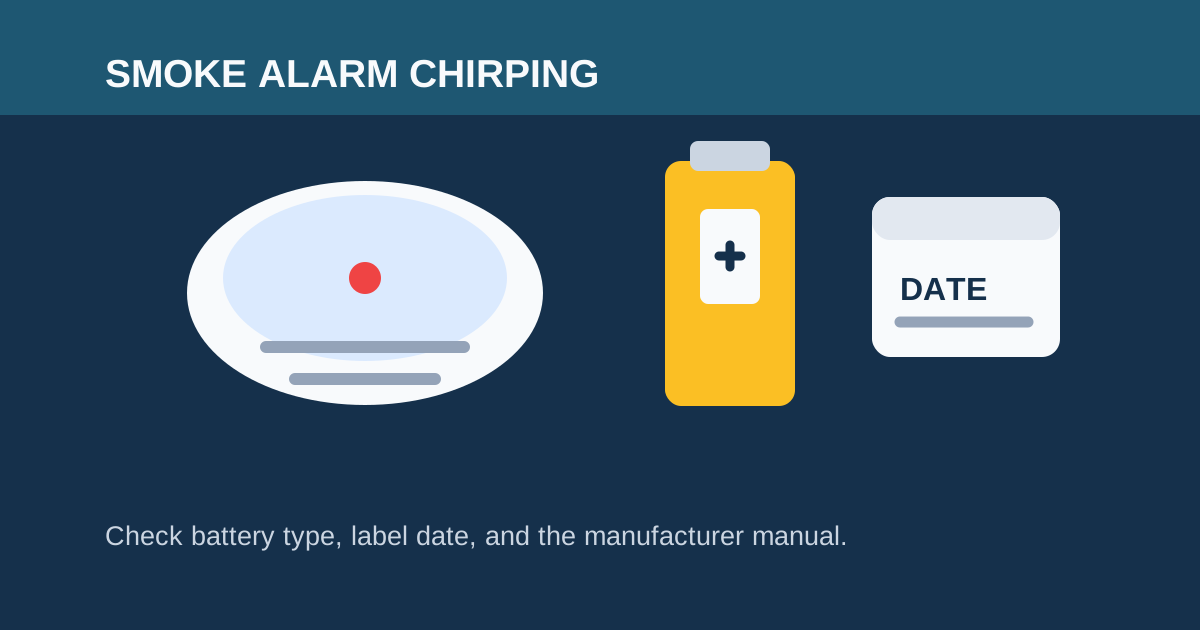
- Read the label. Note the manufacturer, model, battery type, manufacture date, and stated replacement date. A sealed-battery alarm has no user-replaceable battery.
- Use a fresh battery of the specified type. Make sure it is seated correctly and the battery compartment closes fully. Kidde lists an incorrectly installed or loose battery as a common source of intermittent chirping.
- Use only the model’s documented reset steps. Some alarms retain a trouble condition after a battery change. For example, Kidde describes a reset that includes holding the test button after removing power; other models may differ. Check the manual for the exact hold time.
- Check the replacement date. The NFPA says smoke alarms should be replaced after 10 years. Follow an earlier date printed by the manufacturer.
- Clean only as the manufacturer directs. Dust, humidity, steam, temperature change, or airflow can cause trouble signals. Do not spray cleaners or paint into an alarm.
If the chirp persists after these checks, replace an alarm that is at its stated end of life or contact the manufacturer for a unit that is still within its warranty period.
Manufacturer-specific chirp patterns
Different manufacturers use slightly different chirp rates and meanings. The table below summarizes general patterns, but always confirm against your model’s manual:
| Manufacturer | Low battery signal | End-of-life signal | Malfunction signal | Source |
|---|---|---|---|---|
| First Alert | 1 chirp every 60 seconds | 5 chirps every 60 seconds | 3 chirps every 60 seconds | First Alert support docs |
| Kidde | 1 chirp every 30–60 seconds | 1 chirp every 30 seconds (after 10 years) | Varies by model — check manual | Kidde support page |
| Nest Protect (2nd gen, while supported) | Voice announcement + chirp | Voice announcement " Heads-up, this alarm has expired" | Voice announcement with error code | Google Nest support |
If you have a First Alert SC5 (the Nest Protect replacement), the alarm uses 5 chirps per minute to signal end of life and 3 chirps per minute for a malfunction. See First Alert SC5 vs Nest Protect for full specifications.
Why a new battery may not stop the chirp
A new battery cannot correct every problem. Common reasons a chirp continues after a fresh battery:
- Loose connection or unlatched compartment. The battery may be the right type but not seated firmly enough to maintain contact.
- Retained fault condition. Some alarms store a trouble state in memory that requires the model-specific reset procedure to clear. Kidde and First Alert both document this behavior.
- Battery drawer not fully closed. Kidde specifically lists an incompletely closed battery drawer as a chirp cause.
- Environmental contamination. Dust, cooking residue, humidity, or insects inside the sensor chamber can trigger a fault signal that mimics a low-battery chirp.
- End of life. The alarm has reached its replacement age. A new battery cannot restore an expired sensor.
Do not keep resetting a unit that reports a fault or has passed its stated replacement age. For a focused battery-change sequence, read Smoke Detector Chirping After Battery Change. For a sealed unit, use 10-Year Sealed Battery Smoke Detector Chirping.
Hardwired alarms need model-specific care
Hardwired alarms usually have household power plus a backup battery. Turning off a breaker or disconnecting a wiring harness is not a general first step; follow the manufacturer instructions for your model. Do not touch damaged wiring, melted connectors, or a repeatedly tripping circuit. Those require a qualified electrician. Start with Hardwired Smoke Alarm Chirping: Safe Troubleshooting.
For Kidde hardwired alarms specifically, see Kidde Hardwired Smoke Alarm Beeping for brand-specific reset steps and interconnect troubleshooting.
Interconnected systems: finding the source
In homes with interconnected smoke alarms, one unit’s trouble condition can cause all linked alarms to chirp. This is normal behavior — the system is designed to propagate alerts. To find the source alarm:
- Listen at each unit when the chirp occurs. The originating alarm may have a different LED pattern.
- Check the LED indicators on each alarm. Your model’s manual defines what each color and flash rate means.
- Address the source alarm first. Replace its battery and perform the reset. If all units stop chirping, the issue was isolated to that one alarm.
Nighttime chirping
A chirp that starts or is most noticeable at night is common. Batteries produce less voltage at lower temperatures, so a battery near the end of its life may drop below the alarm’s threshold overnight when the house cools down. The fix is the same: replace the battery with a fresh one of the correct type, then follow the model’s reset procedure if needed. For more detail, see Smoke Detector Chirping at Night.
Sources
- NFPA: Learn More About Smoke Alarms
- Kidde: What Causes Intermittent Beeping or Chirping?
- First Alert: Alarm Chirps with New Battery
FAQ
Can I remove the battery to stop the chirp?
No. Do not leave a smoke alarm disabled. Replace the correct battery or replace the entire alarm if it has reached its stated end of life. A disabled smoke alarm provides no protection.
Does a chirp always mean a low battery?
No. A periodic single chirp commonly signals a low battery, but a model can also use a chirp for end of life, a fault, or an environmental issue. Check the manual for your exact model to confirm the meaning.
How often should I replace smoke alarm batteries?
Replace batteries at least once a year, or whenever the alarm chirps. Use only the battery type specified on the alarm label or in the manual. For sealed 10-year alarms, no battery replacement is needed — replace the entire unit at end of life.
Should I replace every smoke alarm at the same time?
Check every unit’s label. Alarms installed at the same time may reach replacement age together, but replace compatible hardwired or interconnected equipment according to the manufacturer instructions.
Why does my alarm chirp only at night?
Batteries produce less voltage at lower nighttime temperatures, so a battery near the end of its life may drop below the alarm’s threshold overnight. Replace the battery with a fresh one of the correct type.