Proper smoke detector placement can be the difference between early warning and tragedy. A smoke detector in the wrong location may not detect smoke in time, may trigger false alarms that cause you to disable it, or may fail building code inspection. This guide explains the placement rules based on NFPA 72 (the US national fire alarm code), how to apply them room by room in a typical US home, and the practical pitfalls to avoid.
Quick Placement Reference
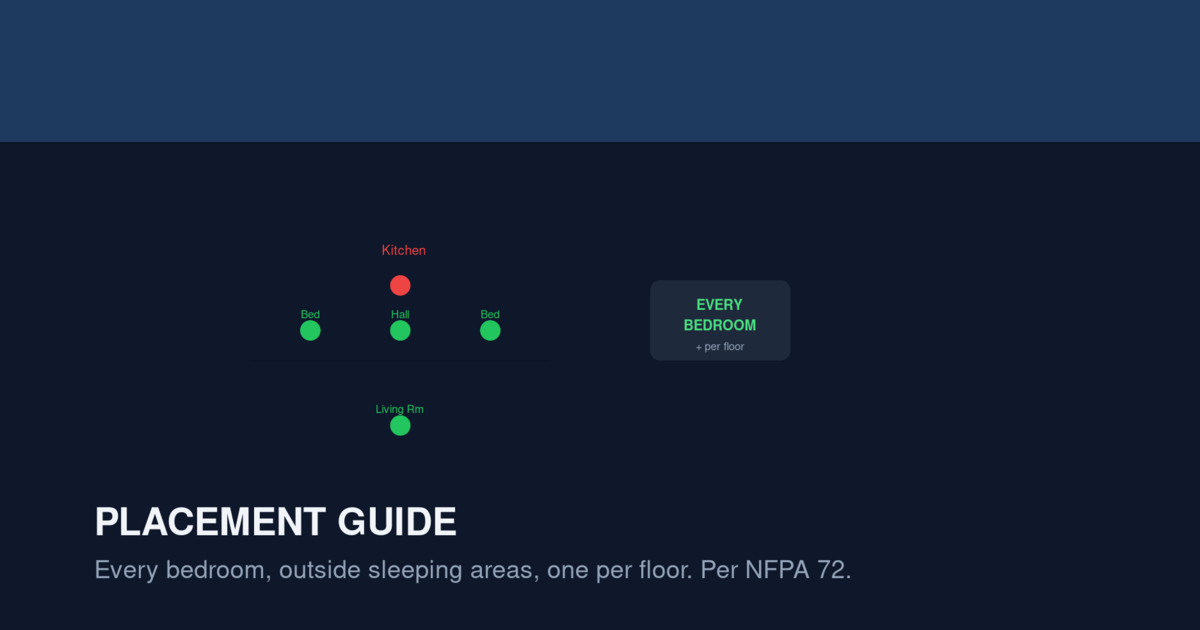
For most US homes, the minimum code-compliant placement is:
- Inside every bedroom — required for new construction in all 50 states since 2011
- Outside every sleeping area — in the hallway, within 21 feet of any bedroom door
- On every level of the home — including basements and finished attics
- At the bottom of every stairway — including basement stairs
- At least 10 feet from cooking appliances — to reduce false alarms while keeping detection coverage
- Mounted on the ceiling or high on the wall — smoke rises
Most US homes need 6-8 smoke detectors to meet these requirements. If your home was built before 2011, you may only have detectors in hallways or on a single level. Adding detectors to meet current code is one of the most cost-effective safety upgrades you can make.
The Codes and Standards Behind US Placement Rules
Smoke detector placement in the US is governed by three layers of rules: federal, state, and local.
NFPA 72: The National Fire Alarm Code
NFPA 72 is published by the National Fire Protection Association and updated every three years. The 2022 edition is the current standard. NFPA 72 is not a federal law, but it is adopted by reference in most state and local fire codes. This means that even though no federal agency enforces NFPA 72 directly, your local building inspector almost certainly follows it.
The key NFPA 72 placement requirements are:
- Smoke alarms must be installed inside every sleeping room
- Smoke alarms must be installed outside every sleeping area, within 21 feet of any bedroom door
- Smoke alarms must be installed on every level of the dwelling, including basements
- Smoke alarms must be installed at the bottom of every stairway leading to an occupied level
- Smoke alarms must be installed in any room or area where flammable liquids are stored
NFPA 72 also includes spacing rules. On a smooth ceiling, smoke alarms must be spaced no more than 30 feet apart. If your ceiling has beams or joists more than 8 inches deep, each beam creates a separate “room” that requires its own detector.
State and Local Variations
States and municipalities often add their own requirements on top of NFPA 72. The most common state-level additions are:
- California: Requires 10-year sealed battery smoke alarms in all rental properties. Also requires hardwired, interconnected smoke alarms in all new construction.
- Massachusetts: Requires photoelectric-only smoke alarms in some jurisdictions to reduce false alarms. Check your local fire department.
- New York: Requires smoke alarms in every bedroom and on every level in rental properties. New York City has additional requirements for buildings with three or more units.
- Florida: Requires smoke alarms in every bedroom and outside each sleeping area in properties built after 1994.
Your local building department or fire marshal’s office can confirm the specific requirements for your jurisdiction. When in doubt, follow NFPA 72 plus any state-specific additions.
Rental Property Requirements
If you rent your home, your landlord is typically responsible for installing and maintaining smoke detectors. As a tenant, you are usually responsible for testing them monthly and notifying the landlord of any problems. If your landlord fails to install adequate detectors, contact your local housing authority.
For full state-by-state rental requirements, see our Smoke Detector Laws by State guide.
Where to Place Smoke Detectors in Each Room
The general rule is “smoke rises,” so smoke detectors should be mounted on the ceiling or high on a wall. But room-specific placement matters.
Bedrooms
Every bedroom needs a smoke detector. This is non-negotiable in modern US code. Place the detector on the ceiling, at least 4 inches from any wall. If you must mount on a wall, place it 4 to 12 inches from the ceiling.
For bedrooms with ceiling fans, mount the detector at least 3 feet from the fan. The fan can blow smoke away from the detector, delaying the alarm.
For bedrooms with sloped ceilings, mount the detector within 12 inches of the peak. Smoke accumulates at the highest point first, so the detector needs to be at the top of the slope.
Hallways Outside Bedrooms
A smoke detector is required in the hallway outside every sleeping area. If two bedrooms share a hallway, one detector in that hallway covers both. If bedrooms are on opposite sides of the home, you need a detector in each hallway.
The detector should be mounted between the bedrooms and the rest of the home, so smoke is detected before it reaches the bedrooms. Place it on the ceiling, 4 to 12 inches from the wall.
Living Rooms and Family Rooms
Living rooms and family rooms with fireplaces or wood stoves need smoke detectors. Even without a fireplace, these rooms often contain electronics, candles, or other ignition sources. Place a detector on the ceiling in the main living area.
Kitchens
Kitchens are tricky. You need a smoke detector near the kitchen, but not so close that cooking smoke triggers false alarms. The recommended distance is 10 to 20 feet from the cooking appliance.
If your kitchen is open to the living area and you cannot maintain 10 feet of distance, install a photoelectric smoke alarm rather than an ionization alarm. Photoelectric alarms are less sensitive to cooking smoke and steam.
Alternatively, install a heat alarm in the kitchen instead of a smoke alarm. Heat alarms trigger when the temperature rises above 135°F, which catches cooking fires but ignores cooking smoke. Heat alarms are not substitutes for smoke alarms but can be used as supplements in the kitchen.
Basements
A smoke detector is required on every level of the home, including basements. Place the detector on the basement ceiling, near the bottom of the stairs leading up. This way, smoke from a basement fire is detected before it spreads upstairs.
If your basement has a finished ceiling (drywall), mount the detector on the finished ceiling. If your basement has exposed joists, mount the detector on the bottom of the joists.
If your basement contains a furnace, water heater, or laundry equipment, place a detector near these appliances. Fires often start in basement utility areas.
Garages
Garages are not typically required to have smoke detectors, but they are recommended. If you store flammable materials or park a vehicle that runs on gasoline, a smoke detector in the garage can catch fires early.
Mount the detector on the ceiling, at least 10 feet from the garage door opener (which can trigger false alarms due to vibration). Do not place the detector directly above a parked vehicle — exhaust fumes can damage the sensor over time.
Attics
Finished attics that are used as living space require smoke detectors. Unfinished attics used only for storage do not require detectors, but if the attic contains a furnace or water heater, install a heat detector to catch fires in these appliances.
Where NOT to Place Smoke Detectors
Incorrect placement can cause false alarms, sensor damage, or reduced detection capability.
Avoid These Locations
- Near bathrooms: Steam from showers can trigger false alarms. Place detectors at least 10 feet from bathroom doors.
- Near cooking appliances: Cooking smoke and heat trigger false alarms. Place detectors 10-20 feet from stoves and ovens.
- Near windows or doors: Drafts can blow smoke away from the sensor. Place detectors at least 4 inches from any supply vent or draft source.
- In dead air spaces: The peak of a cathedral ceiling or the corner between a wall and ceiling can trap dead air where smoke does not reach. Place detectors 4 to 12 inches from the wall, not directly in the corner.
- In unheated spaces: Garages, attics, and crawl spaces that drop below 40°F can cause condensation inside the detector, damaging the sensor. Use a heat detector in unheated spaces instead.
- Near fluorescent lights: Electrical noise from fluorescent ballasts can interfere with some detectors. Place detectors at least 1 foot from fluorescent light fixtures.
- Above ceiling fans: Fans can blow smoke away from the sensor. Place detectors at least 3 feet from ceiling fan blades.
The Peak vs. The Slope
For sloped ceilings (vaulted, cathedral, or A-frame), place the detector within 12 inches of the peak. Do not place it lower on the slope, where dead air can accumulate at the peak and prevent smoke from reaching the sensor.
For tray ceilings (recessed center with raised perimeter), place the detector on the flat ceiling portion, not on the raised perimeter. The flat portion is where smoke will accumulate first.
Ceiling vs. Wall Mounting
Smoke detectors are designed to be mounted on the ceiling, but wall mounting is acceptable if ceiling mounting is not practical.
Ceiling Mounting (Preferred)
Smoke rises, so ceiling placement detects smoke earliest. Mount the detector at least 4 inches from any wall. The center of the ceiling is ideal. If you have multiple detectors, space them evenly throughout the home.
For vaulted or cathedral ceilings, mount the detector within 12 inches of the peak.
Wall Mounting (Acceptable)
Wall mounting is acceptable if ceiling mounting is not possible. Place the detector 4 to 12 inches from the ceiling. Smoke rises to the ceiling first and then travels down the wall; placing the detector 4-12 inches down captures smoke as it travels.
Do not mount wall detectors more than 12 inches from the ceiling. Below 12 inches, smoke concentration is too low to trigger the alarm reliably.
Hardwired vs. Battery Placement Considerations
The placement rules are the same for hardwired and battery-powered detectors, but there are some practical differences.
Hardwired Detectors
Hardwired detectors connect to your home’s electrical system. They require professional installation or a confident DIYer. The detector location must be near an electrical box or accessible wiring.
If you are building a new home, your electrician should pre-wire for interconnected smoke detectors on every level and in every bedroom. Interconnected means that when one detector triggers, all detectors sound the alarm. This is required by code in most jurisdictions for new construction.
Battery-Powered Detectors
Battery-powered detectors are easier to install but require annual battery replacement. If you choose battery-powered detectors, use lithium batteries rather than alkaline. Lithium batteries last 5-10 years vs 1-2 years for alkaline, and they are less likely to leak and damage the detector.
Consider 10-year sealed lithium battery detectors for locations where annual battery replacement is inconvenient, such as high ceilings or attic spaces. See our Best Battery Smoke Detectors for Bedrooms guide for top picks.
Smart Smoke Detector Placement
Smart smoke detectors like the original Nest Protect (now discontinued) and First Alert SC5 add Wi-Fi connectivity and app alerts to standard detection. Placement rules are the same, but smart detectors require Wi-Fi signal at the installation location.
If your bedroom is far from your Wi-Fi router, you may need a Wi-Fi extender to ensure reliable connectivity. Most smart detectors will chirp when they lose Wi-Fi connection, which can be confusing if you do not realize the chirp is a connectivity issue rather than a safety issue.
See our Nest Protect Discontinued Replacement Guide and Nest Protect End-of-Life Guide for details on smart detector maintenance.
Placement for People with Disabilities
Households with hearing-impaired occupants need additional safety measures. Standard smoke detectors rely on audible alarms, which may not wake a person who is hard of hearing or deaf.
For hearing-impaired households:
- Install smoke detectors with strobe lights in bedrooms and hallways
- Use bed shaker alarms that vibrate the pillow when smoke is detected
- Place detectors in every room the hearing-impaired person sleeps in, including living rooms where they spend extended time
- Consider smart detectors that send phone alerts, which can wake a person through vibration
These accommodations are required by the Americans with Disabilities Act (ADA) for some public housing but are recommended for any household with a hearing-impaired occupant.
Placement After a Remodel or Addition
If you remodel your home or add a room, your existing smoke detector placement may no longer be adequate. NFPA 72 requires detector placement to be re-evaluated when structural changes affect fire safety.
Common scenarios:
- Adding a bedroom: Install a detector inside the new bedroom and verify that the hallway detector is within 21 feet of the bedroom door.
- Finishing a basement: Install a detector on the basement ceiling, near the bottom of the stairs.
- Adding a second story: Install detectors on the second story, including inside any new bedrooms.
- Converting a garage to living space: Install detectors in the converted space as you would any other room.
After any remodel, test all detectors in the home to ensure they still communicate with each other (if interconnected) and that their placement is still appropriate for the new layout.
How to Test Your Placement
After installing new detectors or relocating existing ones, test the placement. The simplest test:
- Have one person stand in each room of the home.
- Press and hold the test button on one detector for 5 seconds.
- Verify that all interconnected detectors sound and that every person in the home can hear the alarm.
If a person in a distant room cannot hear the alarm, add another detector closer to that room or upgrade to interconnected detectors throughout the home.
For visual verification, some smart detectors send a phone alert when the test button is pressed. This confirms that the Wi-Fi connection is working at that detector’s location.
Common Placement Mistakes
These are the most frequent mistakes homeowners make. Avoid them.
Mistake 1: One Detector for the Whole Home
A single detector, even if it’s a smart, app-connected model, cannot detect smoke in every room in time. You need a detector in every bedroom, every hallway outside bedrooms, and every level.
Mistake 2: Placing the Detector on a Wall Too Low
Wall-mounted detectors must be 4 to 12 inches from the ceiling. Mounting them lower means smoke concentration is too low to trigger the alarm reliably.
Mistake 3: Disabling Detectors Due to False Alarms
If a detector near the kitchen triggers false alarms, do not remove the battery or take it down. Instead, replace it with a photoelectric detector, move it farther from the cooking area, or install a heat detector in the kitchen.
Mistake 4: Not Replacing After 10 Years
A 10-year-old detector may still chirp when you test it, but the sensor is no longer reliable. Replace all detectors every 10 years, regardless of whether they appear to work.
Mistake 5: Forgetting the Basement
Basement fires are common (furnaces, water heaters, electrical panels) and often undetected because the smoke has to travel up through the entire house before being detected by an upstairs detector. A basement detector catches these fires early.
FAQ
How many smoke detectors do I need in a 3-bedroom house?
A typical 3-bedroom, 2-story US home needs 6-8 detectors: one in each bedroom (3), one in the hallway outside the bedrooms (1), one on the main living level (1), one in the basement (1), and one near any attached garage or utility room (1-2).
Where should smoke detectors be placed in a home with a vaulted ceiling?
Mount the detector within 12 inches of the peak. If the room has multiple peaks, mount one detector per peak. Avoid placing detectors in the dead air space below the peak.
Do I need a smoke detector in every bedroom?
Yes, in all 50 states for new construction since 2011. For older homes, adding bedroom detectors is strongly recommended even if not required.
How far should a smoke detector be from a ceiling fan?
At least 3 feet. The fan can blow smoke away from the sensor, delaying the alarm.
Can I place a smoke detector on a wall instead of the ceiling?
Yes, but mount it 4 to 12 inches from the ceiling. Wall placement is acceptable but not preferred.
Where should smoke detectors be placed in a mobile home?
Same rules apply: inside each bedroom, outside sleeping areas, on every level. Mobile homes often have shorter ceiling heights, so wall placement is more common. Use battery-powered detectors since mobile homes may not have hardwired electrical circuits designed for smoke detectors.
Do I need a smoke detector in the laundry room?
Not required by code, but recommended. Dryer fires are common. If your laundry room is in the basement, the basement detector covers it. If on the main level, consider a heat detector.
How close can a smoke detector be to a vent?
At least 4 inches from any supply vent or cold air return. Drafts can blow smoke away from the sensor.
Related Articles
- Smoke Detector Laws by State — state-specific requirements for rental and owner-occupied homes
- Carbon Monoxide Detector Placement Guide — CO detector placement rules (different from smoke detectors)
- Best Battery Smoke Detectors for Bedrooms — recommended battery-powered detectors for bedrooms
- Best Hardwired Smoke Detector Replacements — for upgrading hardwired systems
- Smoke Detector Replacement Cost — what to budget for upgrading your home’s detectors