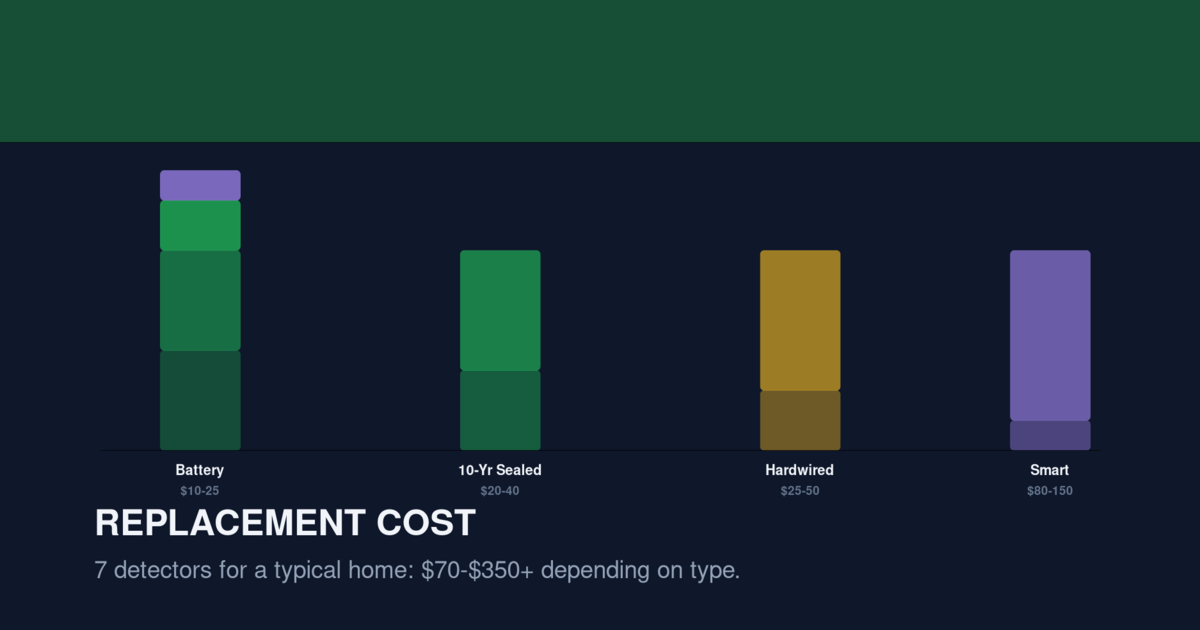
Replacing smoke detectors in a US home in 2026 costs between $20 and $400 per detector, depending on the type and whether you hire an electrician. A typical 3-bedroom home needs 6-8 detectors, so total replacement costs range from $120 for a basic DIY battery-only system to $3,000+ for a smart interconnected system installed by a licensed electrician.
This guide breaks down the actual costs for each type of replacement, when you can do it yourself, and when you need a professional. By the end, you’ll know exactly what to budget for your home.
Quick Cost Reference
For a typical US home needing full smoke detector replacement:
| Replacement Type | Cost Per Detector | Total for 7 Detectors | DIY? |
|---|---|---|---|
| Basic battery-only | $10-25 | $70-175 | Yes |
| 10-year sealed lithium | $20-40 | $140-280 | Yes |
| Photoelectric hardwired | $25-50 | $175-350 | With electrical knowledge |
| Combination smoke/CO hardwired | $40-75 | $280-525 | With electrical knowledge |
| Smart detector (Wi-Fi) | $80-150 | $560-1,050 | Yes |
| Smart detector with pro install | $80-150 + $50-100 labor | $700-1,750 | Hire electrician |
| Full home interconnected system with electrician | $50-150 per unit + labor | $1,000-3,000+ | Hire electrician |
The range is wide because smoke detector pricing varies by brand, features, and whether you’re replacing a single unit or upgrading an entire home system.
The Two Main Costs: Detectors and Installation
Smoke detector replacement has two cost components: the detector itself and the labor to install it. The detector cost is straightforward — it’s the price on the box. The labor cost depends on the type of detector and your home’s existing wiring.
Detector Costs by Type
Basic ionization or photoelectric detectors ($10-25): These are the cheapest units available. They run on 9V or AA batteries and have no smart features. Brands include Kidde, First Alert, and generic store brands. These are acceptable for rental properties and budget installations but lack the reliability and features of more expensive units.
10-year sealed lithium battery detectors ($20-40): These have a sealed lithium battery that lasts the entire 10-year lifespan of the detector. You don’t replace batteries — you replace the entire unit every 10 years. These are required in some states (California, Oregon, Maryland, New York, Louisiana, Wisconsin) for rental properties and are a good investment for any homeowner who doesn’t want to remember annual battery changes.
Combination smoke/CO detectors ($30-75): These detect both smoke and carbon monoxide in a single unit. They’re required in many jurisdictions for new construction and are a smart upgrade for any home. Most hardwired combination detectors cost $40-75, while battery-only combination units start at $30.
Hardwired photoelectric detectors ($25-50): These connect to your home’s electrical system with a backup battery. Photoelectric sensors are less prone to false alarms from cooking than ionization sensors. They’re a mid-range option that balances cost and reliability.
Smart smoke detectors ($80-150): These connect to Wi-Fi and send alerts to your phone. Examples include the First Alert SC5 (the closest current replacement for the discontinued Nest Protect). Smart detectors cost more upfront but provide remote alerts, self-testing, and integration with smart home systems.
Installation Costs
DIY installation: Free if you can do it yourself. Battery-only detectors require no tools and take 5 minutes to install. Hardwired detectors require basic electrical knowledge — turning off the breaker, connecting wires, and mounting the bracket. If you’re comfortable with simple electrical work, you can install hardwired detectors yourself.
Electrician labor ($50-100 per detector or $150-300 minimum): Most electricians charge a minimum service fee plus per-detector labor. For a full home replacement (6-8 detectors), expect $400-1,200 in labor. This includes running new wire if needed, replacing old interconnected wiring, and verifying that the system meets code.
Home security company install ($100-200 per detector): Companies like ADT, Vivint, and SimpliSafe charge a premium for installation. You’re paying for the convenience of having someone else handle it and for ongoing monitoring services. This is rarely cost-effective compared to a one-time electrician visit.
DIY vs Hiring an Electrician
The decision to DIY or hire an electrician depends on the type of detector and your home’s existing wiring.
When You Can DIY
You can replace smoke detectors yourself if:
- You’re replacing battery-only units. No wiring involved. Twist off the old detector, twist on the new one.
- You’re replacing a hardwired unit with the same model. Most hardwired detectors use a simple plug-in connector. Turn off the breaker, unplug the old unit, plug in the new one.
- You’re adding new battery-only units. Mount the bracket, attach the detector. No wiring needed.
For these jobs, you need only basic tools: a screwdriver, a ladder, and possibly a drill if you’re mounting to a hard surface. The whole job takes 30 minutes to an hour for a full home.
When You Need an Electrician
Hire an electrician if:
- You’re upgrading from battery-only to hardwired. This requires running new wire from your electrical panel to each detector location. This is not a DIY job for most homeowners.
- You’re replacing the entire interconnected system. If your existing hardwired system is more than 20 years old, the wiring may need to be replaced. An electrician can assess the wiring and update it to current code.
- You’re adding interconnected detectors where none existed before. Running interconnect wire between detectors requires accessing walls and ceilings. An electrician can do this with minimal damage.
- Your local code requires permits for smoke detector work. Some jurisdictions require a permit and inspection for new electrical work. An electrician handles the permit process.
Full Home Replacement Costs
Most US homes need 6-8 smoke detectors to meet modern code. Here’s what a full home replacement actually costs in 2026.
Scenario 1: Budget DIY Replacement
You have an existing battery-only system that’s expired. You replace it with new 10-year sealed lithium battery detectors.
- 7 detectors at $25 each = $175
- Optional: batteries are included, so no additional cost
- Total: $175
This is the cheapest option and meets code in most jurisdictions. The downside is no interconnection — if one detector triggers, the others don’t sound.
Scenario 2: Mid-Range DIY Replacement
You upgrade to hardwired interconnected detectors but install them yourself.
- 7 hardwired photoelectric detectors at $40 each = $280
- Wire nuts, mounting hardware, electrical tape = $20
- Tools you need to buy (if you don’t have them): wire stripper, voltage tester = $40-80
- Total: $340-380
This gives you a properly interconnected system that meets modern code. You save $400-1,000 over hiring an electrician, but you need basic electrical knowledge.
Scenario 3: Mid-Range Professional Replacement
Same as Scenario 2, but you hire an electrician.
- 7 detectors at $40 each = $280
- Electrician labor at $50-100 per detector = $350-700
- Permit (if required) = $50-150
- Total: $680-1,130
You’re paying for the convenience of having a licensed professional handle the installation and ensure code compliance.
Scenario 4: Smart Detector Replacement
You replace your existing system with smart interconnected detectors and install them yourself.
- 7 smart detectors at $120 each = $840
- Tools and hardware = $40-80
- Total: $880-920
You get app alerts, remote testing, and smart home integration. Installation is no harder than mid-range hardwired detectors if you have electrical knowledge.
Scenario 5: Full Smart System with Professional Installation
Same as Scenario 4, but with an electrician handling the install.
- 7 smart detectors at $120 each = $840
- Electrician labor at $75-150 per detector = $525-1,050
- Permit (if required) = $50-150
- Total: $1,415-2,040
This is the most expensive option but provides the best combination of features and code compliance. Some jurisdictions require professional installation for interconnected systems, so check local code.
Cost-Saving Tips
Smoke detector replacement is one of the more affordable home safety upgrades, but there are still ways to save money.
Buy in Bulk
Most retailers offer discounts when you buy multiple detectors at once. Amazon, Home Depot, and Lowe’s frequently have 4-packs and 6-packs of identical detectors at 10-20% off per unit. If you’re replacing all detectors in your home at once, buy a bulk pack.
Time Your Purchase
Smoke detector prices spike during fire safety awareness months (October is Fire Prevention Month) when demand is high. Prices are typically lower in February and March, after the holiday season and before spring cleaning. Buy in late winter if you can wait.
Consider Combo Units
Combination smoke/CO detectors cost more than smoke-only detectors ($40-75 vs $10-25), but they replace two devices. If you need both smoke and CO detection in the same location, a combo unit saves money compared to buying two separate detectors.
Reuse Existing Wiring
If you’re replacing hardwired detectors, reuse the existing wiring and mounting brackets. Most hardwired detectors use a standard mounting plate that fits multiple brands. You can upgrade from a $25 basic detector to a $50 smart detector without any electrical changes.
Don’t Overbuy Features
Smart detectors with app alerts and voice announcements are nice but not necessary for safety. A $25 photoelectric detector provides the same life-saving function as a $150 smart detector. If budget is tight, prioritize basic coverage over features.
Check for Utility Rebates
Some utility companies and fire departments offer rebates or free smoke detectors. Check with your local fire department and electric utility before purchasing. California in particular has programs that provide free 10-year sealed detectors to qualifying homeowners.
Hidden Costs to Watch For
Beyond the detector and labor costs, there are some hidden costs that can surprise homeowners.
Code Compliance Upgrades
If your home was built before 2011, your existing wiring may not support interconnected detectors. Upgrading to interconnected detectors requires running new wire between units, which can cost $500-2,000 in additional electrical work depending on your home’s construction.
Ceiling or Wall Repairs
If you’re moving detector locations, you may need to patch and paint ceilings or walls where old detectors were mounted. This is minor cosmetic work but adds $50-200 in materials if you hire a handyperson.
Permit Fees
Some jurisdictions require a permit for new electrical work, including smoke detector installation. Permit fees range from $50-300 depending on your location. The electrician typically handles the permit process and includes the fee in their quote.
Monitoring Fees
Smart detectors can connect to professional monitoring services that alert emergency responders when an alarm triggers. These services typically cost $10-30 per month. If you choose a monitoring service, factor in the ongoing cost, not just the initial detector price.
Battery Replacement
Battery-only detectors need new batteries every 1-2 years (alkaline) or every 5-10 years (lithium). Over the 10-year lifespan of a detector, you may spend $20-50 on batteries per unit.
When Replacement Is Worth the Cost
Some replacements are clearly worth the investment. Others can wait.
Replace Immediately
- Any detector that has triggered a trouble alert that won’t clear
- Any detector past its 10-year expiration date
- Any detector that has been recalled (see our Kidde Recall Guide for active recalls)
- Any detector that has visible physical damage
- Any detector that fails a self-test
Replace Soon (Within 3-6 Months)
- Detectors between 7-10 years old, especially in critical locations like bedrooms
- Detectors with frequent false alarms (may indicate sensor degradation)
- Detectors that chirp intermittently even after battery replacement
Replace When Convenient
- Detectors under 7 years old with no issues
- Detectors in non-critical locations (attics, garages)
- Detectors that are still under manufacturer warranty
DIY Step-by-Step for Battery-Only Replacement
If you’re replacing battery-only detectors yourself, here’s the exact process:
Purchase the right detectors. Buy 10-year sealed lithium battery units for low-maintenance operation. Make sure you have one for every bedroom, hallway outside bedrooms, and level of the home.
Gather tools. You need a stepladder, a screwdriver (Phillips or flathead depending on the mounting bracket), and possibly a drill if mounting to a hard surface like concrete or metal.
Remove the old detector. Twist the detector counterclockwise to release it from the mounting bracket. Some detectors have a small tab you need to press while twisting.
Remove the old mounting bracket. Unscrew the bracket from the ceiling or wall. Some brackets are attached with plastic anchors that pull out easily.
Install the new mounting bracket. Screw the new bracket into the same holes if possible. If the old holes are stripped, use slightly larger screws or wall anchors.
Attach the new detector. Twist the new detector onto the bracket until it clicks into place.
Test the detector. Press and hold the test button. The alarm should sound loudly for several seconds.
Record the installation date. Use a permanent marker to write the installation date on the inside of the battery compartment, or note it in your phone. This helps you remember when to replace the unit.
The whole process takes 5-10 minutes per detector. For a full home of 7 detectors, allow 1-2 hours.
DIY Step-by-Step for Hardwired Replacement
If you’re replacing hardwired detectors with the same model:
Turn off the power. Go to your electrical panel and turn off the breaker for the smoke detector circuit. Verify the power is off by pressing the test button on an existing detector — it should not respond.
Remove the old detector. Twist counterclockwise to release from the mounting bracket.
Disconnect the wiring harness. Most hardwired detectors have a plug-in connector. Press the tab and pull to disconnect. Do not pull on the wires.
Remove the old mounting bracket. Unscrew from the ceiling or wall.
Install the new mounting bracket. Use the existing screw holes if possible.
Connect the new wiring harness. Plug the connector into the new detector. The connector only fits one way.
Mount the new detector. Twist clockwise onto the bracket.
Restore power. Turn the breaker back on.
Test the detector. Press and hold the test button. The alarm should sound.
Test interconnection. Press and hold the test button on one detector. All interconnected detectors should sound within a few seconds.
If your new detector is a different brand or model than the old one, the wiring harness may not be compatible. In that case, you may need to rewire the connector. This is more involved and may require an electrician if you’re not comfortable with electrical work.
What About Smart Detector Installation?
Smart detectors install the same way as basic hardwired detectors — the only difference is the Wi-Fi setup. After physical installation:
Download the app. Most smart detectors require a smartphone app for setup (First Alert app for the SC5, which then links to Google Home, etc.).
Create an account. Some apps require an account, which may include a subscription for advanced features.
Connect to Wi-Fi. The app walks you through connecting the detector to your home Wi-Fi network. This usually takes 2-5 minutes per detector.
Name each detector. Most apps let you assign a name and location to each detector (“Hallway Smoke Alarm,” “Master Bedroom,” etc.).
Test through the app. Most apps include a remote test feature that lets you verify the detector is working without pressing the physical test button.
How Long Does Smoke Detector Replacement Take?
For a full home replacement:
- Battery-only DIY: 1-2 hours for 7 detectors
- Hardwired DIY: 2-4 hours for 7 detectors, plus extra time for breaker identification and wire management
- Hardwired with electrician: Half day (4-6 hours) for a full home
- Smart detector setup: Add 1-2 hours for Wi-Fi configuration and app setup after physical installation
Most electricians can complete a full home hardwired replacement in a single visit. If the wiring needs significant updates, the job may take 1-2 days.
Is It Worth the Cost?
Smoke detectors are one of the most cost-effective safety devices you can buy. A complete home system for $200-400 (DIY) provides life-saving protection for 10 years. The cost per year of protection is $20-40, or about $2-3 per month.
Compare that to a home security system ($30-60/month), carbon monoxide detector ($20-40 for 7 years), or even basic smoke alarm batteries ($20/year). Smoke detectors are one of the best safety investments per dollar.
If cost is a barrier, prioritize the most critical locations first: bedrooms and hallways outside bedrooms. These are where fires are most likely to occur while people are sleeping. Add additional detectors over time as budget allows.
FAQ
How much does it cost to replace one smoke detector?
A single smoke detector costs $10-150 depending on type. DIY installation is free; electrician installation adds $50-100.
Can I install smoke detectors myself?
Yes, for battery-only units and like-for-like hardwired replacements. For new wiring, interconnected systems, or code-required installations, hire an electrician.
How much do electricians charge for smoke detector installation?
Most electricians charge $50-100 per detector, with a $150-300 minimum service fee. For a full home, expect $400-1,200 in labor.
Are 10-year smoke detectors worth it?
Yes. The sealed lithium battery eliminates annual battery changes and reduces false low-battery warnings. They’re required in some states for rentals.
What is the cheapest way to replace smoke detectors?
Buy a 4-pack or 6-pack of basic battery-only detectors. You’ll spend $40-100 for a partial home replacement. Add more over time as budget allows.
Should I replace all smoke detectors at once or one at a time?
Replace all at once if they’re all the same age. If they’re different ages (because some were replaced individually), replace the oldest ones first and work toward the newer ones.
Does homeowner’s insurance cover smoke detector replacement?
No, smoke detectors are considered regular home maintenance. Insurance covers damage from fires, not the cost of the detectors themselves.
Are smart smoke detectors worth the extra cost?
If you want app alerts and remote monitoring, yes. If you just need basic detection, a $25 detector provides the same life-saving function as a $150 smart detector.
How often should I replace smoke detector batteries?
For alkaline batteries, replace annually. For 10-year sealed lithium batteries, replace the entire unit when the battery dies.
Can I get free smoke detectors?
Some fire departments and utility companies offer free smoke detectors, especially in low-income areas or for seniors. Check with your local fire department.
Related Articles
- Smoke Detector Placement in US Homes — where to place the detectors you buy
- Best Battery Smoke Detectors for Bedrooms — recommended battery-powered options
- Best Hardwired Smoke Detector Replacements — for upgrading hardwired systems
- How Often to Replace Smoke Detectors — replacement timeline by type
- Kidde Smoke Detector Recall Guide — check before you buy